How to Get a Virtual Dollar Card in Nigeria Without the Hidden Fees or Declines
If you run online payments or subscriptions as an individual, an agency that manages client campaigns, or build digital products in Nigeria, you don't need a lecture on why local bank cards fail. You've seen "Transaction Declined by Issuer" enough times to know that traditional Naira debit cards are virtually unusable for international spending under current foreign exchange policies.
You've likely tried the alternatives — domiciliary accounts with steep parallel market markups, bureau de change (BDC) runs, begging contacts abroad for their cards, or bouncing between fintech apps only to get hit with frozen accounts, hidden conversion spreads, or sudden insufficient funds penalties.
This article skips beginner basics. Instead, it provides a realistic breakdown of what virtual dollar cards actually cost, where most cards on the market fall short, why they decline, and how Squareme gives you a stable, transparent setup for smooth global payments.
The True Cost of "Cheap" Virtual Dollar Cards in Nigeria
Many fintech platforms market "$1 virtual dollar cards." However, the initial creation fee is only a fraction of what you actually pay over time.
When running digital ads, hosting client infrastructure, or paying for SaaS tools (Notion, Figma, Slack, Adobe, CapCut, Canva, or AWS et cetera), small recurring charges add up. We call them hidden charges.
To evaluate the true cost of a virtual dollar card, look closely at four key metrics: the card creation fee, failed attempt charges, card maintenance fees, and FX spread markup (conversion fees).
This is why the cost of using a virtual dollar card in Nigeria can vary from as little as $2 or as high as hundreds of dollars, depending on the platform used. The table below explains in detail.
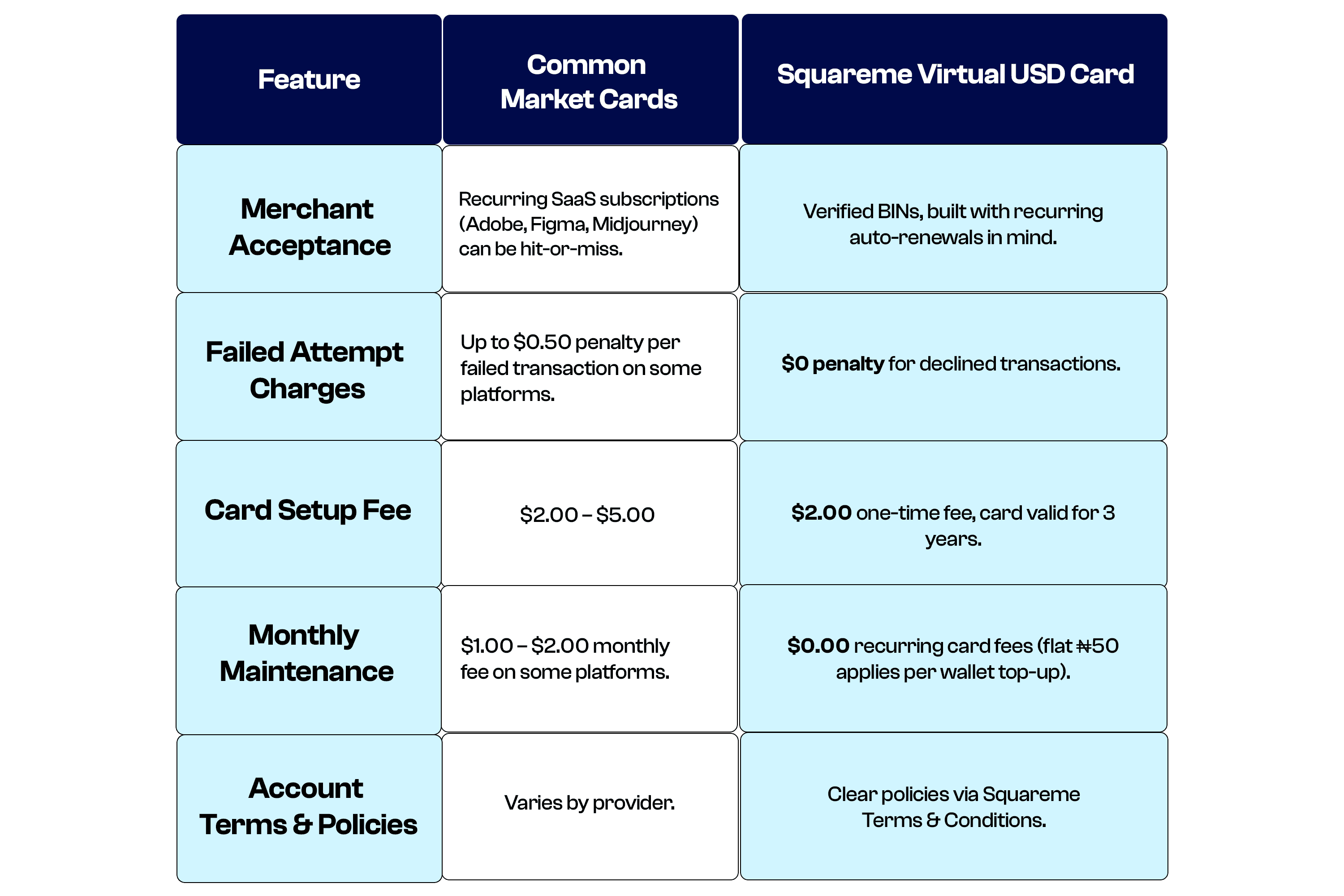
Squareme virtual dollar card vs other platforms/banks
Why Nigerian Virtual Dollar Cards Decline on Major Foreign Platforms
Nothing ruins a client campaign faster than having a Meta Ad account flagged because a virtual card was rejected as a "high-risk prepaid card."
Many fintech apps generate cards using generic, low-grade Bank Identification Numbers (BINs). Major payment gateways (Stripe, Chase Paymentech, Adyen) are more likely to flag or block generic BIN ranges, since these are more frequently associated with disposable trial accounts or fraudulent activity.
Squareme issues cards, on the other hand, are backed by tier-1 global card networks (Visa/Mastercard) with established BIN ranges. When you attach your card to a recurring subscription, it's more likely to be registered as a standard USD debit account rather than flagged as disposable — though no card issuer can guarantee approval on every platform, since final risk decisions sit with the merchant's payment processor.
A Direct Comparison: Finding A Virtual Dollar Card That Works for You
No single platform fits every requirement. Here's a general landscape overview so you can choose the right tool for your workflow:
- Multi-currency banking apps: Platforms like Grey By Raenest and Cleva are a strong choice if you need dedicated foreign bank accounts (USD, EUR, GBP) to receive payment directly from overseas clients. If you need to send payments to foreign bank accounts, they are strong contenders for this category as well as some dollar card transactions - although you might hit a blocker on platforms like Distrokid or Adobe with these platforms. For pure day-to-day card spending in Nigeria, funding spreads and cross-border conversion fees build quickly on these apps unlike with Squareme.
- General-purpose spending apps: Platforms like Kuda or Opay work fine for minor casual purchases. Power users running agency ad spend however, often run into tighter daily transaction limits or per-transaction processing fees as volume grows or platforms change. This is where Squareme comes in. You can attach your dollar card for monthly subscriptions on international platforms, pay for work tools, or simply check-out and clear your shopping cart on international e-commerce sites and be assured that it’ll work.
- Platform-Specific Spending: Squareme was built for the SaaS needs of Nigerian freelancers, business owners, and agency leads who need a virtual dollar card without monthly maintenance fees or decline problems. If you fall into this category, and need to set up a card urgently for an impending payment or tool, here’s how to it:
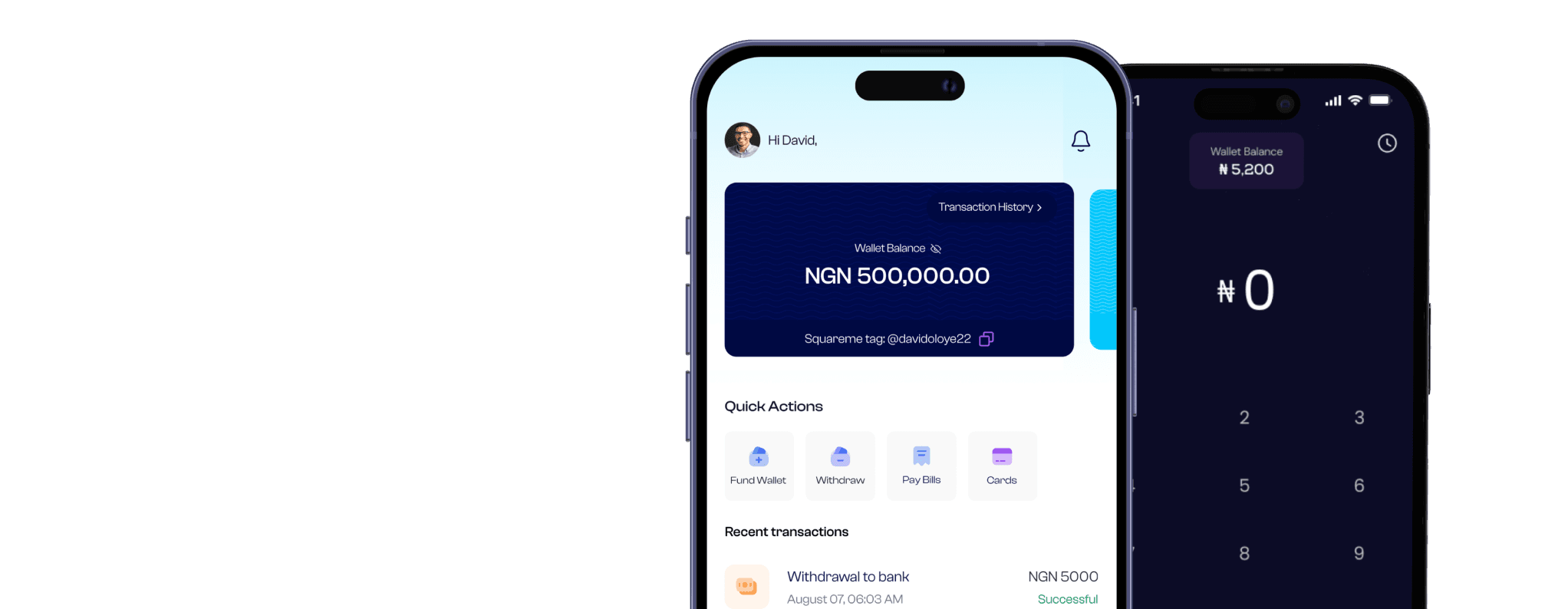
How To Get Your Virtual Dollar Card With Squareme in 3 Minutes
If you need a working USD card right now to clear a blocked invoice, you can complete the setup in four simple steps:
Step 1: Download Squareme & Verify Identity
Install Squareme on iOS or Android. Complete signup and run through the necessary KYC checks (usually with your Bank Verification Number (BVN) or National Identification Number (NIN) for tier-level approval).
Step 2: Fund Your Virtual Wallet
Transfer funds from any local bank app directly to your dedicated Squareme virtual wallet. A flat ₦50 deposit fee applies per transfer, regardless of the amount as stipulated by the Central Bank of Nigeria (CBN).
Step 3: Generate Your Virtual USD Card
Navigate to the Cards tab, select Create Dollar Card, and approve the initial $5 minimum deposit.
- $2 covers your one-time card creation fee (valid for 3 years), and the remaining $3 drops directly onto your card balance as active spending money.
Step 4: Access Details & Execute Payment
Tap to reveal your 16-digit card number, expiration date, CVV, and registered billing address. Copy and paste these directly into your target merchant's checkout gateway.
[ Local Deposit ] ──► [ Flat ₦50 Fee ] ──► [ USD Conversion ] ──► [ Instant Card Funding ]
Pro-Tip for High Spenders: Keep a $3–$5 buffer on your card above your exact purchase total. Global gateways (Google, Amazon, Meta) often issue temporary $1 hold charges to verify active card accounts before processing the main charge. Three consecutive failed charges due to zero balance can lead to automatic card deactivation to protect your account.
Ready to stop losing money and time to card transactions that decline?
Download Squareme now and generate a working virtual dollar (USD) card in under 3 minutes.
Frequently Asked Questions
1. How much does it really cost to get a Squareme virtual dollar card?
Answer: You need a minimum of $5 to get started. $2 covers the one-time card creation fee (valid for 3 years), and the remaining $3 goes straight onto your card as a spending balance. There's no monthly maintenance fee.
2. Do I need a BVN or NIN to sign up?
Answer: Yes. Squareme requires standard KYC verification using either your Bank Verification Number (BVN) or National Identification Number (NIN), depending on your tier-level approval.
3. How do I fund my card, and what fees apply? Answer: You fund your Squareme wallet via local bank transfer, then move funds to your card. A flat ₦50 deposit fee applies per transfer, regardless of the amount — this is a CBN-stipulated charge, not a Squareme markup.
4. Will my card work on platforms like Meta Ads, Amazon, Adobe or Google? Answer: In all cases, yes. Squareme cards run on established Visa/Mastercard BIN ranges rather than generic, low-grade BINs, which makes them less likely to be flagged as disposable or high-risk by payment processors. That said, no card issuer can guarantee approval on every platform — final risk decisions ultimately sit with the merchant's payment processor. If you run into any difficulties, our customer support team is available to walk you through it.
5. Why do some charges get declined even when I have a balance?
Answer: Many international gateways (Google, Amazon, Meta) place a temporary $1 hold to verify the card before processing the actual charge. If your balance is too tight, this can trigger a decline. Keeping a $3–$5 buffer above your purchase total helps avoid this. In some cases, the platform in question may likely have been flagged as fraudulent or suspicious by Visa or Mastercard, and the decline happens for your safety.
6. What happens if my card fails multiple charges? Answer: Three consecutive failed charges due to a zero balance can lead to automatic card deactivation, as a protective measure for your account.
7. How is Squareme different from apps like Grey or Raenest? Answer: Multi-currency wallet apps like Grey or Raenest are better suited if you need dedicated foreign bank accounts (USD, EUR, GBP) to receive payments from overseas clients. Squareme is built specifically for digital spending — subscriptions, work tools, and platform checkout (Temu, AliExpress, Miumiu, Jumia, Konga, Chowdeck, Glovo etc) — This includes our physical cards — without the funding spreads and cross-border fees that add up on wallet-focused apps.
8. How long does it take to get a card?
Answer: Once you've downloaded the app and completed KYC, generating the card itself takes about 3 minutes.
9. Does the card expire?
Answer: No — once created, your Squareme virtual dollar card is valid for 3 years from issuance.